A million-cell lineage tree of one mouse embryo, rooted at the zygote.
NextCell is an interactive browser for a single-cell lineage tree of the E13.5 mouse embryo — 1,281,141 profiled cells, about 10% of the embryo at that stage, reconstructed from DNA Typewriter recordings and dated in embryonic time. Every tip is one profiled cell; every internal node is a dated common ancestor.
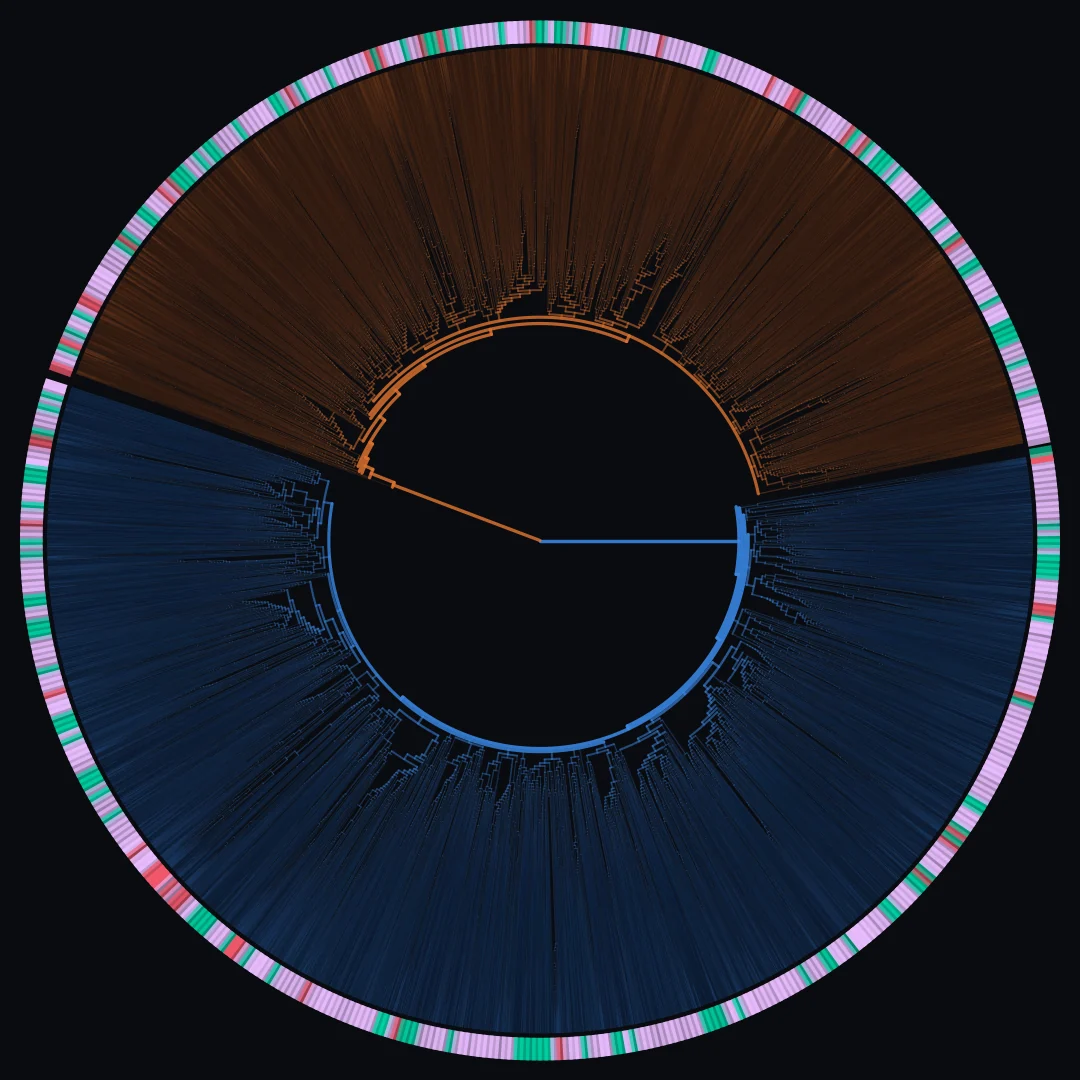
John Sulston and colleagues mapped the complete embryonic cell lineage of the worm C. elegans by watching its cells divide under a microscope. A mouse embryo is far too large and opaque for that, so this one recorded its own lineage: as its cells divided, a prime editor wrote short DNA symbols, in order, into engineered “tapes” in each cell’s genome. Reading those records in 1.28 million single cells sampled from the embryo at E13.5, together with each cell’s transcriptome, let us reconstruct one tree, rooted at the zygote and dated in embryonic time. NextCell lets you browse that tree, download it, and explore the analyses built on it.
How it was recorded
schematicThe eleven tapes fill at different rates, so a cell's recorder is a staircase rather than a block; the colours below are the 13 symbols, in the paper’s palette.
Five views
The first two are the trees themselves; the other three are analyses built on them. Every view is linkable — the bar at the top of the browser always holds a URL that encodes the current tab and all of its settings.
Every QC-passing cell, placed onto the backbone. Click a clade to see its consensus edit pattern, its cell-type composition, and its cells projected onto the UMAP.
≈43 MB Backbone tree → 655,701cells · reference coreThe cells with at least 7 genotyped tapes, built without placement; every analysis is anchored to it. Splits into the two blastomeres at E1.5: 410,925 cells and 244,776 cells.
≈24 MBWhere every cell in the embryo was, at every moment — at germ-layer, trajectory or cell-type resolution.
≈4 MB Origins → 82cell typesFor one E13.5 cell type, how many ancestral lineages it descends from over time, and what those ancestors were.
≈6 MB Traceback → 275qualifying pathsThe qualifying paths into one cell type, as defined in the paper, shown as separated bars, a continuous stream, or one non-crossing row per path.
≈12 MBFigures from the paper, live in NextCell
- Fig. 3B: ancestral node
n1703121, an endodermally fated progenitor dated to E7.4, whose 662 sampled descendants include hepatocytes, branchial arch epithelium, midgut/hindgut epithelium and lung progenitors. - Fig. 6E–G: the ancestral-state views, State flow, Origins and Traceback.
The trees
| Tree | Tips | Internal nodes | Notes |
|---|---|---|---|
Whole embryonextcell_full_tree_dated.nwk.gz |
1,281,141 | 1,109,894 | All QC-passing cells, placed onto the backbone. |
Backbone treenextcell_backbone_tree_dated.nwk.gz |
655,701 | 648,928 | Cells with at least 7 genotyped tapes, built without placement; the reference all analyses are anchored to. |
Both are dated in embryonic time from the zygote (E0) through two blastomeres (E1.5) to all tips at E13.5. The dating places 656 lineages at E6.5; branch lengths are continuous, and the viewer's time axis is computed from them directly.
Cell-type calls
Tips
Each profiled cell carries a cell-type call, a major-trajectory assignment and a germ-layer assignment transferred from the mouse embryo atlas of Qiu et al. 138 cell types, 25 trajectories and 6 germ layers are represented. Germ-layer assignments are lineage-validated.
Internal nodes (ancestral states)
Ancestral cell types were imputed by walking up the tree in half-day steps and matching each node to the atlas in UMAP space with a mutual-nearest-neighbour strategy. 926,852 of the 1,054,879 internal nodes within the atlas interval (88%) carry a call, with coverage lowest early (46% at E8.75) and best late (96–98% between E11.5 and E13.0).
These per-node calls are not shown in the two tree browsers. Individually they are too noisy to read one at a time, so the browsers display only what is reconstructed — topology, dating, edit patterns, and the composition of a clade's own profiled cells. The imputed layer is used only in the three analysis views, and only behind an explicit filter.
Download the trees
Both trees are written directly from the same artifacts this browser is built from, so their topology, dating and node numbering are identical to what you see on screen. Newick format, gzipped. Branch lengths are in days, so a node's age is the sum of branch lengths from the root: the root sits at E0.0 and every tip at E13.5 (the trees are ultrametric to within about 3.3 seconds).
Labels. Tip labels are cell_id values, the join key for the single-cell
metadata. Internal labels are n<id>, where the id is the node's preorder index
and matches the node numbering used by this browser — note that the full tree and the backbone
tree number their nodes independently, so n1234 is not the same node in both
files. These are identifiers only: the imputed ancestral cell-type calls are deliberately not
included in these files, since they are model output rather than reconstruction, and are
better read in context in the browser.
Loading the trees
In Python with TreeSwift, which reads the gzipped file directly (about half a minute for the full tree on a laptop):
import treeswift, pandas as pd

tree = treeswift.read_tree_newick("nextcell_full_tree_dated.nwk.gz")
age  = {n.label: d for n, d in tree.distances_from_root()}   # days since the zygote
meta = pd.read_csv("cell_metadata.v8.txt.gz", sep="\t").set_index("cell_id")
tips = meta.loc[[n.label for n in tree.traverse_leaves()]]   # one row per cell in the tree
The cell metadata file is in the code repository; see Data & code.
Data & code
| Item | Location |
|---|---|
| Dated lineage trees (full + backbone) | Above, on this page |
| Analysis and figure code | github.com/shendurelab/dtt-mouse Archived at Zenodo: 10.5281/zenodo.22801270 |
| Sequencing data (bulk tape amplicons and single-cell RNA-seq) | GEO GSE341627 Includes gene-count matrices (Matrix Market .mtx plus per-cell
and per-gene .csv) for the 7 single-cell sequencing runs. |
| Processed cell metadata (cell type, major trajectory, UMAP) | cell_metadata.v8.txt.gz
in the code repository · 57 MB · 1,584,848 cells |
| Qualifying traceback paths | Table S8 of the paper; all 275 are browsable in Traceback |
| Reference atlas | Qiu et al., A single-cell time-lapse of mouse prenatal development from gastrula to birth. Nature (2024) |
| License | Data CC BY 4.0 · code GPL-3.0 (see the repository) |
Citation
Yu Q†, Kim H†, Seidel S†, Acosta-Clark JF, Martin BK, O’Connor K, Daza RM, Gasperini M, Nathans JF, Lam M, Gamo E, VijayKumar S, Kuo L, Lalanne J-B, Simeonov KP, Pepper M, Trapnell C, Gray JM, Choi J, Qiu C*, Shendure J*. A DNA Typewriter records the cell lineage history of a mouse, from zygote to late organogenesis. Science (2026). https://doi.org/10.1126/science.ael0508
† Qi Yu, Haedong Kim and Sophie Seidel contributed equally. * Corresponding authors: [email protected], [email protected]
Preprint: In vivo reconstruction of the cell lineage history of a developing mouse with DNA Typewriter, from zygote to late organogenesis. bioRxiv (2026). https://doi.org/10.64898/2026.07.29.741625
BibTeX
@article{yu2026dnatypewriter,
  title   = {A {DNA} Typewriter records the cell lineage history of a mouse,
             from zygote to late organogenesis},
  author  = {Yu, Qi and Kim, Haedong and Seidel, Sophie and Acosta-Clark, James F. and Martin, Beth K. and O'Connor, Kyle and Daza, Riza M. and Gasperini, Molly and Nathans, Jenny F. and Lam, Maggie and Gamo, Elena and VijayKumar, Shruthi and Kuo, Lauren and Lalanne, Jean-Beno{\^i}t and Simeonov, Kamen P. and Pepper, Marion and Trapnell, Cole and Gray, Jesse M. and Choi, Junhong and Qiu, Chengxiang and Shendure, Jay},
  journal = {Science},
  year    = {2026},
  doi     = {10.1126/science.ael0508}
}
Affiliations
- Department of Genome Sciences, University of Washington, Seattle, WA, USA
- Seattle Hub for Synthetic Biology, Seattle, WA, USA
- Howard Hughes Medical Institute, Seattle, WA, USA
- Allen Institute, Seattle, WA, USA
- Medical Scientist Training Program, University of Washington, Seattle, WA, USA
- Present address: Département de Biochimie et Médecine Moléculaire & Courtois Institute for Biomedical Innovation, Université de Montréal, Montréal, QC, Canada
- Public Health Sciences Division / Translational Research Program, Fred Hutchinson Cancer Center, Seattle, WA, USA
- Department of Immunology, University of Washington, Seattle, WA, USA
- Brotman Baty Institute for Precision Medicine, Seattle, WA, USA
- Institute of Stem Cell and Regenerative Medicine, University of Washington, Seattle, WA, USA
- Allen Discovery Center for Cell Lineage Tracing, Seattle, WA, USA
- Present address: Developmental Biology Program, Memorial Sloan Kettering Cancer Center, New York, NY, USA
- Department of Molecular and Systems Biology, Dartmouth College, Hanover, NH, USA
- AI BioDesign, Seattle, WA, USA
Credits
Acknowledgements
We thank the members of the Shendure lab, the Seattle Hub for Synthetic Biology, Allen Discovery Center for Cell Lineage, and UW Genome Sciences communities for helpful discussions over the course of many years (particularly the Shendure/SeaHub Recording subgroup, A. Schier, M. Elowitz, R. Waterston, and W. Colgan). We also thank the Transgenic Colony Management, Neurosurgery & Behavior, Lab Animal Services, and the Veterinary Services teams at the Allen Institute for their contributions to animal work. The content is solely the responsibility of the authors and does not necessarily represent the official views of the NIH. This research was supported in part by the Brotman Baty Institute for Precision Medicine, as well as the Allen Institute, founded by Jody Allen – chair and co-founder of Allen Family Philanthropies, and the late Paul G. Allen – investor, philanthropist, and co-founder of Microsoft. We gratefully acknowledge their vision and generosity, which make this work possible. J.S. is an Investigator of the Howard Hughes Medical Institute.
Funding
- Allen Institute (JS)
- Brotman Baty Institute for Precision Medicine (JS)
- Cancer Research Society of Canada grant 1155581 (J-BL)
- Chan Zuckerberg Initiative Foundation, Seattle Hub for Synthetic Biology award CZIF2023-008738 (JS, CT, MP)
- Charles H. Hood Foundation, Inc., MA (CQ)
- Damon Runyon Cancer Research Foundation grant DFS-64-24 (JC)
- Damon Runyon Cancer Research Foundation grant DRG-2435-21 (J-BL)
- Howard Hughes Medical Institute (JS)
- National Institutes of Health grant R00HG012973 (JC)
- National Institutes of Health grant P30CA008748 (JC)
- National Institutes of Health grant P20GM130454, via Dartmouth’s Center for Quantitative Biology (CQ)
- Paul G. Allen Frontiers Group, Allen Discovery Center for Cell Lineage Tracing (JS, CT)
- Searle Scholars Award SSP-2025-101 (JC)
- Swiss National Science Foundation Postdoc. Mobility fellowship grant 239394 (SS)
- Washington Research Foundation Postdoctoral Fellowship (HK)
Competing interests
The University of Washington has filed a patent application related to DNA Typewriter (US20240355418A1), on which JC and JS are listed as inventors. JS is on the scientific advisory board, a consultant, and/or a co-founder of 10x Genomics, Cellular Intelligence, Guardant Health, Pacific Biosciences and Phase Genomics. CT is a paid consultant for 10x Genomics and holds equity in the company. KPS is a member of the Translational Advisory Council at SeaBridge, Allen Institute. All other authors declare no competing interests.
AI disclosure
Several authors used AI-based tools during this work. The NextCell interactive browser was built with Claude Code (Anthropic). Data exploration, data analysis, data visualisation, and code development were additionally supported by Claude Opus 5, Claude Opus 4.7, and Claude Sonnet 5 (Anthropic), which were also used to improve the readability and language of the manuscript. AI-assisted tools were not used to generate or alter primary data, to draw scientific conclusions, or to perform other key authoring tasks. All AI-assisted code, analyses, and text were reviewed, tested, and edited by the authors, who take full responsibility for the data, code, analyses, and conclusions presented here.
On the name and the mark
This browser owes an obvious debt to Nextstrain, and the NextCell mark is an intentional homage to theirs: a disc of flat, spectrally coloured facets. The geometry is our own — where Nextstrain’s mark is a globe, ours is a radial dendrogram, one cell at the centre dividing outward, which is how Fig. 3A of the paper draws this tree. The artwork is original and NextCell is not affiliated with, endorsed by, or connected to the Nextstrain project.






NextCell · nextcell.seattlehub.org · Shendure lab, University of Washington and the Seattle Hub for Synthetic Biology · Code · Updated October 2026